POST OVERVIEW. The second in a series of studies of Revelation 20:1-3 seeking to determine when “the thousand years” occur. This specific study attempts to determine when Jesus binds Satan in the abyss (Rev. 20:2-3). (See also post #668, 9/10/2023.)
REVIEW
This article is the second in a series of studies focused on Revelation 20:1-3 whose objective is to determine when, in human history, “the thousand years” (“the MILL”) occurs. In our first study (Post #668, 9/10/2023), we discovered the following:
- “The dragon” represents Satan (20:2). (Thus, whenever we encounter “the dragon” in Revelation, we know that we have encountered Satan.)
- “The angel” (20:1) represents the Lord Jesus.
- The MILL begins when the Lord Jesus binds Satan and throws him into the abyss.
- At the end of the MILL, Satan is released from the abyss for a short time.
This second study is intended to begin to answer the crucial question, “WHEN does Jesus bind Satan in the abyss?”
As we consider this question and review the passage in Revelation 20:1-3, it may at first appear that we have reached a cul-de-sac. It may seem that there is no way to figure out when Jesus binds Satan in the abyss at the beginning of the MILL. Where do we go from here?
JESUS BINDS SATAN. First, there is significance in the fact that it is Jesus who binds Satan in the abyss. Jesus is King of kings and Lord of lords and He reigns over heaven and earth, but He, as the God-Man, can only be in one place at a time. This fact will help us as we explore the question of when Jesus binds Satan.
Thinking broadly, one thing we can say for certain is that Jesus’ binding of Satan takes place after His resurrection and subsequent ascension to heaven (Acts 1:9) and before the inauguration of the new heaven and the new earth (Rev. 21:1). We also know with certainty that, at some point in time, Jesus is coming from heaven to judge the earth. Those realities are illustrated in the figure below.

BASIC TIMELINE: CHRIST TO NEW HEAVENS NEW EARTH
- R = resurrection of Christ
- C = Christ commissions His church (Matt. 28:18-20)
- A = Christ’s ascension (Acts 1:9)
- V = Christ’s arrival in heaven (Revelation 5:6)
- X = Christ’s coming (παρουσία) (Revelation 19:11-21)
- NHNE = new heavens and the new earth (Rev. 21-22)
Next, recalling that Jesus as God-Man can only be in one place at a time (see above), we will refine our crucial question and ask, “WHEN could Jesus bind Satan in the abyss?” Our study of the Scriptures will reveal that there are only two times when it is possible for Jesus to bind Satan in the abyss.
As we prepare to expand our study to the books outside of Revelation, it is appropriate to remind ourselves of the nature of this amazing Bible that we hold in our hands.
THE POWER AND BEAUTY OF THE SCRIPTURES
The beauty of the Bible is that each of its 66 books has been inspired by the same Author, the Holy Spirit. Because all Scripture is God-breathed (2 Tim. 3:16), the Bible is both interconnected and consistent.
It is interconnected in that each book of the Bible fits together with the other books to form a cohesive whole. Just as each piece of a jigsaw puzzle is necessary to complete the whole puzzle, so the books of the Bible connect with each other to form the whole message of God to man. Because this is the case, we can allow Scripture to interpret Scripture as one portion of the Word illumines and informs another portion.
And the Bible is consistent in that there is no contradiction between the individual books, but instead there is a God-breathed harmony. Despite including writings of poetry and prophecy, narrative history and Mosaic Law, gospels and epistles and apocalypse, the themes and doctrines pictured throughout the Bible do not contradict or conflict with one another but rather reinforce and complement one another. This means that the better we know our Bibles, the more confident we become about its power to guide us into all truth.
In 2 Tim. 2:15, Paul exhorts Timothy, “Be diligent to present yourself approved to God as a workman who does not need to be ashamed, accurately handling the word of truth.” Confident of the power of the Scriptures, we are now going to accurately handle the word of truth and go to other Scriptures outside of Revelation to answer these crucial questions.
FROM REVELATION 20 TO PSALM 110
For this part of our study we will leave Revelation 20 and turn to Psalm 110. This psalm is both Messianic and eschatological and will teach us about Christ’s reign after His ascension to heaven. We will focus our attention on Psalm 110:1.
The Lord says to my Lord:
“Sit at My right hand
Until I make Your enemies a footstool for Your feet.” – Psalm 110:1
Here in Psalm 110:1 we see one Person of the Godhead (the LORD) speaking to another Person of the Godhead (the Lord). The conversation is between God the Father and God the Son, and the nature of the conversation reveals the occasion of this verse. This verse takes place after Jesus has accomplished His work of atonement on the cross (John 19:30, etc.), has been raised from the dead, and has ascended back to heaven. Now (ca. AD 30) the Father welcomes the victorious Son back to heaven and seats Jesus in the place of honor at the Father’s right hand until the time comes for Jesus to return to earth for the Judgment (“make Your enemies a footstool”). So, according to Psalm 110:1, from the time of Jesus’ return to heaven until His coming to earth in judgment, He is seated at the Father’s right hand in heaven.
Other verses in Scripture confirm this reality. In Ephesians 1:20, Paul tells us that “the Father raised Him (Jesus) from the dead and seated Him at His right hand in the heavenly places.” Hebrews 1:3 says, “When He had made purification of sins (the cross), He sat down at the right hand of the Majesty on high.” The same point is made in Hebrews 8:1 and 12:2, but the clearest expression of this is in Hebrews 10:12-13:
12 but He, having offered one sacrifice for sins for all time, sat down at the right hand of God, 13 waiting from that time onward until His enemies be made a footstool for His feet.
The time when “His enemies (will) be made a footstool for His feet” refers to the time when Christ will rise from His seat at the Father’s right hand and will come back to earth to judge the unrighteous. These Scriptures teach us that:
- Jesus is seated at the Father’s right hand from the time He ascended to heaven (ca. AD 30) until He returns to earth for the Judgment.
We are going to add this new discovery to our chart. (See below.)
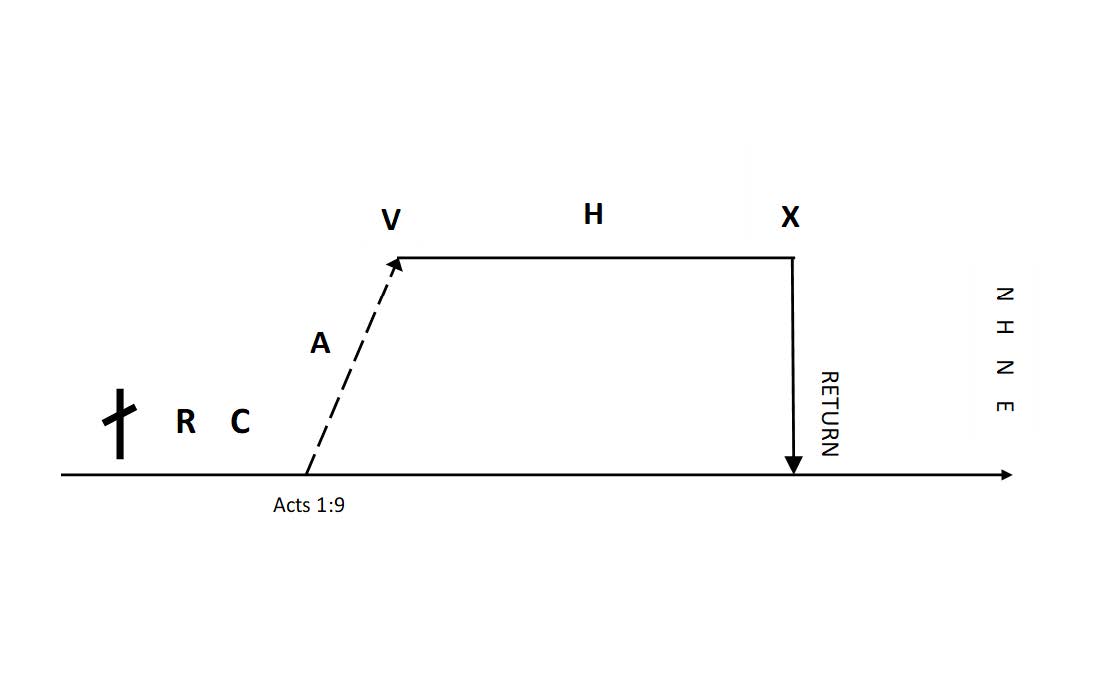
BASIC TIMELINE: CHRIST TO NEW HEAVENS NEW EARTH
- R = resurrection of Christ
- C = Christ commissions His church (Matt. 28:18-20)
- A = Christ’s ascension (Acts 1:9)
- V = Christ’s arrival in heaven (Revelation 5:6)
- H = Christ’s reign at Father’s right hand (Ps. 110:1; Heb. 10:12-13)
- X = Christ’s coming (παρουσία) (Rev. 19:11-21)
- NHNE = new heavens and the new earth (Rev. 21-22)
Thus we can logically say that, while Jesus is seated at the Father’s right hand (H) in heaven, He cannot at the same time bind Satan in the abyss. In other words, the event of Jesus binding Satan in the abyss cannot take place between the time of Jesus’ arrival in heaven (V – Rev. 5:6) and His coming to earth as Judge (X – Rev. 19:11-21; etc.) because He is seated at the Father’s right hand.
Since that is the case, we can see from our chart that there are only two times when Jesus could bind Satan in the abyss. The first possibility would be after His return (His παρουσία), and the second possibility would be for Him to bind Satan while He is ascending to heaven between Acts 1:9 and Rev. 5:6ff. And this is the answer to the crucial question we asked above about WHEN Jesus could bind Satan in the abyss. These possibilities are illustrated in the figure below. (“B” stands for “binding.”)

The question is, “How do we decide between these two possibilities?” That will be the subject of our next study.
Soli Deo gloria rmb 9/11/2023 #669
 Roy's Reflections