The order of the resurrection in 1 Thessalonians 4:13-17

(This post will be a chapter in my upcoming book, “The Resurrection: when the church is glorified,” which will be published in 3Q 2024.)

THE RESURRECTION SO FAR IN 1 THESSALONIANS

Before we dig into our focus passage, which is explicitly about the resurrection of the saints, we will briefly review what Paul has already said implicitly about the resurrection earlier in the letter.

2:19. “For who is our hope or joy or crown of exultation? Is it not even you, in the presence of our Lord Jesus at His coming (παρουσία)?” Paul and the Thessalonians will both be “in the presence of the Lord Jesus at His coming” (παρουσία). “In the presence of the Lord Jesus” must be with the Lord Jesus.

This agrees with 4:16-17, where the dead in Christ and those who are alive and remain will be “caught up together to meet the Lord in the air.” This also agrees with 3:13 (below).

3:13. “He (the Lord) may establish your hearts without blame in holiness before our God and Father at the coming (παρουσία) of our Lord Jesus with all His saints.”

The first key word here is with (μετὰ followed by genitive). Jesus will be coming “with all His saints.” It is important to note that the coming of our Lord Jesus will not be for His saints, which would mean that His saints are still on earth, but His coming will be with His saints, which means that His saints are already in the air (4:17). Since “the Lord Himself will descend from heaven” (4:16), we conclude that the resurrection of the saints occurs immediately before “the coming (παρουσία) of our Lord Jesus,” and then Jesus returns with all His saints.  

The second key word is all (πάντων). Jesus will be coming “with all His saints.” This means that none of the elect will be missing. All the dead in Christ plus all those who are “alive and remain” will be with Jesus at His coming (παρουσία).

KEY POINT: The resurrection of the saints must occur immediately before Jesus’ coming (παρουσία). And this is exactly what we see in Paul’s teaching in 4:13-17.

THE ORDER OF THE RESURRECTION IN 1 THESSALONIANS 4:13-17

13 But we do not want you to be uninformed, brethren, about those who are asleep, so that you will not grieve as do the rest who have no hope.

4:13. Paul is prompted to tell about the resurrection (of the saints) because the Thessalonians are unclear about the events of the last day. Thus Paul begins by talking about “those who are asleep” (i.e., those believers who have already physically died), but he quickly moves to teach about the resurrection of all believers, whether asleep or living.

14 For if we believe that Jesus died and rose again, even so God will bring with Him those who have fallen asleep in Jesus. 15 For this we say to you by the word of the Lord, that we who are alive and remain until the coming (παρουσία) of the Lord, will not precede those who have fallen asleep. 16 For the Lord Himself will descend from heaven with a shout, with the voice of the archangel and with the trumpet of God, and the dead in Christ will rise first. 17 Then we who are alive and remain will be caught up together with them in the clouds to meet the Lord in the air, and so we shall always be with the Lord.

4:14. The first phrase of this verse bears on the fact of Jesus’ bodily resurrection. A paraphrase might be, “Since Jesus was resurrected . . .”

In 1 Cor. 15:1-23, Paul makes a more detailed case for the certainty of Christ’s resurrection from the dead and for how Christ’s resurrection guarantees the resurrection of all those in Christ, but here the apostle makes clear that, as Christ died and rose again, “even so (οὕτως) God will bring with Him (i.e., with Christ; see 3:13) those who have fallen asleep in Jesus.”

Paul’s message to the Thessalonians in this verse is, “Do not be worried or anxious about those who have fallen asleep (i.e., physically died). Know for certain that these will be with the Lord Jesus when He returns.”

Now the apostle will go on to describe the events of the resurrection of the saints and how the resurrection relates to the coming (παρουσία) of the Lord Jesus.

4:15. Paul’s first phrase communicates the idea that what follows is God-breathed doctrine and is, therefore, trustworthy and true (“the word of the Lord”). Then the apostle tells us that, at the coming of the Lord, the saints who are alive and remain will be resurrected after those saints who have fallen asleep (i.e., died). Even at this point in the passage, we can begin to discern the order of the resurrection, but with 4:16-17, Paul will remove all ambiguity.

4:16-17. In these two verses, Paul gives us the most explicit teaching found in Scripture about the order of the resurrection.

The events begin with the announcement of the coming of the King when we will hear a shout (of command), the voice of an archangel and the trumpet of God sounding together (4:16), declaring to the entire world that, “NOW Jesus is coming! The King of kings is coming to judge the earth” (Psalm 96:13; 98:9; 2 Tim. 4:1).

After the announcement of Jesus’ coming, we discover that “the dead in Christ will rise first.” All those in Christ who have physically died will be resurrected first. Immediately after this comes the resurrection of the living, whom Paul describes as those “who are alive and remain.” Finally, as “the Lord Himself descends from heaven,” all the resurrected saints rise up together “to meet the Lord in the air.”

This passage in 1 Thess. 4 answers many questions about the resurrection of the saints, but it also leaves a few questions unanswered.

A COUPLE OF UNANSWERED QUESTIONS

Question: When do these events of the resurrection occur? Even though Paul’s teaching explicitly connects the return of Jesus Christ, which occurs on the last day, with the resurrection of the saints, it is possible that some may still be unclear on when the resurrection occurs.

Answer: According to Jesus in John 6:39, 40, 44 and 54, and according to John 11:24, the resurrection occurs on the last day. Since this is explicitly stated five times in John’s gospel, this answer is unambiguous. THE RESURRECTION OCCURS ON THE LAST DAY.

Question: In this passage (1 Thess. 4:13-17), we have seen that, on the last day, all the dead in Christ are resurrected, then all those believers who were still living (“alive and remain”) are resurrected, then they both rise together to meet the descending Lord Jesus in the air. But Paul does not disclose what happens next other than to say that “so we shall always be with the Lord.” The question that follows is, “What happens after the resurrected saints meet the descending Lord Jesus in the air on the last day?”

Answer: Jesus continues to descend to earth with His saints to destroy all the unrighteous. Explanation: Perhaps the best cross-reference for this is Rev. 19:11-21. This passage is the climax of the book of Revelation and pictures the Lord Jesus riding on a white horse as He comes (or “descends”) to judge the nations. “From His mouth comes a sharp sword, so that with it He may strike down the nations; He treads the wine press of the fierce wrath of God, the Almighty” (19:15). The awesome scene has an overwhelming sense of finality and concludes in 19:21 with the Lord killing all the unrighteous of the earth. And in the midst of this passage, in Rev. 19:14, we read of “armies clothed in fine linen, white and clean, following Him (Jesus) on white horses.” These armies are all the resurrected saints who have risen “to meet the Lord in the air” (1 Thess. 4:17) and who are now “following Him on white horses” as He descends in judgment. (See also 1 Thess. 3:13; 4:14.)

Restating the answer, then, AFTER THE SAINTS MEET THE LORD IN THE AIR, THE LORD AND HIS ARMIES OF RESURRECTED SAINTS CONTINUE TO EARTH TO RENDER FINAL JUDGMENT ON ALL THE UNRIGHTEOUS.

Other passages that confirm this interpretation about what happens when Jesus comes from heaven are Jer. 25:30-38, Rev. 6:12-17 and any Old Testament passage that talks about “the day of the Lord.” Another consideration is Psalm 110:5-6, a powerful psalm about Jesus’ return in judgment. When the Lord (Adonai) comes “in the day of His wrath” (110:5), “He will judge among the nations, He will fill them with corpses, He will shatter the chief men over a broad country” (110:6). The point is that, when the Lord Jesus comes in His παρουσία (1 Thess. 4:15), He is coming to judge the earth (Ps. 96:13; 98:9).

Soli Deo gloria            rmb                 5/6/2024                     #700
When does the resurrection occur? (John 6:39, 40, 44, 54)

OVERVIEW. A brief article reviewing Jesus’ teaching in the gospel of John chapter 6, which tells us that the resurrection occurs on the last day. To be included in “The  Resurrection: when the church is glorified.”

WHEN DOES THE RESURRECTION OCCUR?

Many of the questions about the resurrection are complex, but the question of when the resurrection occurs is straightforward. The resurrection occurs on the last day. Jesus unambiguously declares this four times in the gospel of John, in John 6:39, 40, 44, and 54 (“I will raise him up on the last day”). Our Lord is here obviously speaking about the resurrection of the righteous, and that resurrection occurs on the last day. Later in the gospel, Martha testifies to Jesus about Lazarus, her brother, “I know that he will rise again in the resurrection on the last day (John 11:24).” Nothing could be clearer.

IMPLICATIONS OF THIS TEACHING

Since the resurrection occurs on the last day, we know the “when” of all passages which talk about the resurrection. If the passage is speaking about the resurrection of the saints, then the passage is speaking about the last day. For example, in 1 Thess. 4:14-17, Paul teaches us about the order of the resurrection.

1 THESSALONIANS 4:14-17

14 For if we believe that Jesus died and rose again, even so God will bring with Him those who have fallen asleep in Jesus. 15 For this we say to you by the word of the Lord, that we who are alive and remain until the coming of the Lord, will not precede those who have fallen asleep. 16 For the Lord Himself will descend from heaven with a shout, with the voice of the archangel and with the trumpet of God, and the dead in Christ will rise first. 17 Then we who are alive and remain will be caught up together with them in the clouds to meet the Lord in the air, and so we shall always be with the Lord.

4:14. On the last day, God will bring with Jesus the resurrected saints who had previously been dead in Christ (“asleep in Jesus”).

4:15. Those in Christ who are living at the time of the coming of the Lord will not be resurrected before those who are dead in Christ.

4:16. On the last day, the Lord Jesus Himself will descend from heaven, then those who are dead in Christ will be resurrected first.

4:17. Then the disciples of Jesus who are physically alive on the last day will be resurrected, and they will join those who were physically dead in Christ to meet the descending Lord Jesus (4:16) in the air.

CONCLUSION

From this study we have learned the following truths:

  1. The resurrection occurs on the last day. (John 6:39, et. al.)
  2. The resurrection of the dead in Christ and of those who are alive in Christ occurs together on the last day. (1 Thess. 4:16-17) Thus, all those in Christ are resurrected on the last day.
  3. Christ returns on the last day (1 Thess. 4:16) concurrent with the resurrection.
  4. Those who are resurrected will come with Christ on the last day (1 Thess. 4:14; confirm 3:13).

Soli Deo gloria            rmb                 4/4/2024                     #698

John 11:25-26. “I am the resurrection and the life.”

POST OVERVIEW. An exposition of John 11:24-26 for my upcoming book on “The Resurrection: When the church is glorified.”

The death of Jesus’ friend Lazarus provides the context for this very famous quote from our Lord about His identity and about the resurrection of the saints. Martha has complained to the Lord that, if He had come earlier, Lazarus would not have died. Jesus responded by telling her that her brother would rise again.

11:24. Martha states the doctrine of the resurrection; namely, that there will be resurrection of the dead on the last day. But Martha does not connect the resurrection with Jesus or with faith in Jesus. Her understanding of the resurrection is incomplete.

11:25. Jesus said, “I am the resurrection and the life.” Jesus is the central figure in the resurrection on the last day. He is the one who orchestrates the resurrection and who gives eternal life to all who believe in Him.

“He who believes in Me . . .” We pause here to make the critical point that only believers in Jesus will be a part of the resurrection of the righteous. If you believe in Jesus; that is, if you have denied yourself and taken up your cross daily and followed Jesus (Luke 9:23); if you have passed from death to life (John 5:24); if you have been born again (John 3:3, 5); if you have been justified by faith (Rom. 5:1), then Jesus’ words apply to you. If not, then you are heading toward a resurrection of judgment (John 5:29) and a place in the lake of fire (Rev. 20:15).

So, Jesus’ words here are good news only for those who believe in Jesus.

Jesus, as the resurrection and the life, says, “He who believes in Me . . . will live . . . even if he dies.” In the Garden, the LORD God had warned Adam about sin: “The day you eat of it, you will surely die” (Gen. 2:17). Ever since Adam’s first sin, death has reigned over all men because of their sin. “The soul who sins will die” (Ezek. 18:4). My sin guaranteed my death and there was no escape available.

But now Jesus declares, “He who believes in Me will live even if He dies.” To anyone who believes in Him, Jesus makes a promise that renders physical death inconsequential. Our Lord promises that the believer will live. In the garden, God warned Adam that his sin would result in death, but now the Son of God declares that the one who believes in Him will live. Look carefully and you will see that Jesus has taken sin out of the equation. God said that if Adam sinned, he would die, but now Jesus says if the sinner believes, he will live.

Notice that “will live” is in the future tense. When Jesus, who is the resurrection and the life, promises that the believer will live, He is speaking about the believer’s eternal life. We see then that Jesus is saying, “He who believes in Me will live forever in heaven.” And we know that in heaven we will be in our eternal glorified state. In other words, based on Jesus’ promise, it is a settled certainty that he who believes in Jesus will live forever in heaven in glory.

“He who believes in Me will live . . . . even if He dies.” Once you have passed from spiritual death to eternal life (John 5:24) as a result of believing in Jesus, your future glorified life in heaven is guaranteed regardless of whether you are physically alive or dead. In other words, physical death does not affect your spiritual life and cannot rob you of your promised glorified body. Jesus has promised that you will live. Because of this, the believer should no longer fear physical death. Because of my faith in Jesus, my physical death has become a non-event. I am awaiting the resurrection when I will receive my glorified body even if my physical body has died.

But there is another aspect to this short phrase, “even if he dies.” We will receive our glorified body even if we physically die, but there is also the possibility that we will not physically die. In other words, the resurrection may occur while my physical body is yet living. What happens then? Jesus does not explain this possibility in this passage, but Paul has clearly explained this in 1 Thess. 4:15-17 and in 1 Cor. 15:51-52. If the resurrection occurs when the believer is yet living, then he will be quickly changed (1 Cor. 15:52) and will receive his glorified body without having to go through death.

Regardless of your physical circumstances, whether you are asleep or you are alive and remain, you will receive your eternal glorified body in the resurrection.

11:26. “and everyone who lives and believes in Me will never die.” The previous verse talked about the physical aspects of the resurrection, but this verse speaks about the eternal spiritual rewards of believing in Jesus as Lord and God. Jesus declares that everyone who believes in Him will live forever. By his faith in Jesus, the believer has received eternal life and cannot die. Everyone who does not believe in Jesus is dead in their sins (Eph. 2:1), but everyone who believes in Him has forever passed from death to life (John 5:24) and therefore will never die. Eternal life is theirs. Once again, physical death poses no threat to the believer because, whether alive or asleep, he possesses eternal life.

SUMMARY

Mary and Martha were saddened because their brother, Lazarus, was dead, and they were confused because Jesus had not prevented their brother’s death. But Jesus’ message to them is one of immense encouragement: “For everyone who believes in Me, physical death is of no consequence. Believe in Me and you will rise in glory in the resurrection and spend eternity in heaven with Me. I am the resurrection and I am the One who gives eternal life.”

Do you believe this?

Soli Deo gloria            rmb                 2/26/2024                   #696

The thousand years: Part 3 – When is Jesus coming?

POST OVERVIEW. The third in a series of studies of Revelation 20:1-3 seeking to determine when “the thousand years” occur. This specific study seeks to determine when Jesus binds Satan in the abyss by determining from the Scriptures when Jesus’ coming (παρουσία) occurs. (See also post #668, 9/10/2023, post #669, 9/11/2023.)

REVIEW THE PROGRESS OF OUR STUDY

This article is the third in a series of studies focused on Revelation 20:1-3 whose objective is to determine when, in human history, “the thousand years” (“the MILL”) occurs. In our two previous studies (Post #668, #669), we established the following:

  • “The dragon” represents Satan (20:2).
  • “The angel” (20:1) represents the Lord Jesus.
  • The MILL begins when the Lord Jesus binds Satan and throws him into the abyss.
  • At the end of the MILL, Satan is released from the abyss for a short time.
  • Jesus is seated at the Father’s right hand from the time He ascended to heaven (ca. AD 30) until He returns to earth for the Judgment.
  • There are only two times when Jesus could bind Satan in the abyss, either after His coming (παρουσία) or while He is ascending to heaven between Acts 1:9 and Rev. 5:6ff.

The chart below illustrates the progress we have made up to this point in our study.

Our first two studies left us here, knowing that the binding of Satan (B) and the MILL that follows must be located in one of these two places. (See post #669 for how we reached this conclusion.) The question is, “How do we decide between these two possibilities?” Answering that question will be the subject of this study. 

OUR APPROACH. Our approach for deciding between these two options is pretty simple, at least in concept. We have two alternative scenarios, but only one of them is correct. If we can eliminate one of the alternatives or show, by the Scriptures, that one of them is not possible, then we would be left with the correct one. So, we are going to seek to show from Scriptures that one of these two options is not possible.

STEP ONE. Referring to our chart above, we will focus on the coming (“the return”) of Jesus and ask another crucial question: “WHEN does the coming (παρουσία) of Jesus take place?” For this portion of our study, we will once again leave Revelation and explore 1 Thess. 4:15-17.

As we read 1 Thess. 4:15, it is obvious that we are reading a passage about the coming (παρουσία) of the Lord. The next verse, 4:16, removes all ambiguity when Paul writes, “For the Lord Himself will descend from heaven with a shout.” It is certain that these verses describe Jesus coming to earth.

But also notice what is going on at the same time. While Christ is descending from heaven, “the dead in Christ will rise” (4:16) and then “we who are alive and remain will be caught up together with them to meet the Lord in the air” (4:17). Paul is writing about the resurrection when all those who are in Christ, whether living or dead, will receive their glorified bodies. It is the same topic that Paul teaches in 1 Cor. 15:52: “In a moment, in the twinkling of an eye, at the last trumpet; for the trumpet will sound, and the dead will be raised imperishable, and we will be changed.” Again, we see that all the saints, whether living or dead, will receive their resurrection bodies at the same time. And the resurrection will occur when Christ returns, for 1 Cor. 15:22-23 says, “For as in Adam all die, so also in Christ shall all be made alive. But each in his own order: Christ the first fruits, after that those who are Christ’s at His coming.” Thus, the Scriptures declare that all those who are Christ’s will be resurrected (glorified) at the time of His coming.

  • Our conclusion is that the coming (παρουσία) of Jesus and the resurrection of the saints occur at the same time.

We will now add the resurrection (“S”) to our chart. (See below.)

STEP TWO. Now we ask another crucial question: “WHEN does the resurrection of the saints take place?” Because Jesus’ coming and our resurrection occur at the same time, if we can determine from the Scriptures when the resurrection occurs, then we will also know when Christ’s coming takes place.

For this answer, we turn to the gospel of John and listen to the teaching of Jesus. In John 6:39, our Lord says:

“This is the will of Him who sent Me, that of all that He has given Me I lose nothing but raise it up on the last day.”

Here Christ clearly teaches that the resurrection occurs on the last day. But this is not the only time Jesus says this.

John 6:40: “I Myself will raise him up on the last day.”

John 6:44: “I will raise him up on the last day.”

John 6:54: “I will raise him up on the last day.”

Four times from the lips of Jesus we are told that the resurrection occurs on the last day. There is another instance of this in John 11:24 when Martha said to Jesus, “I know that he (Lazarus) will rise again in the resurrection on the last day.” Martha knows that the resurrection will occur on the last day. Also, notice that Jesus does not correct her, but rather affirms her theology with the words. “I am the resurrection and the life; he who believes in Me will live even if he dies” (11:25). The point is that five times in the gospel of John the Scriptures declare that the resurrection occurs on the last day.

  • Therefore, we must conclude that the resurrection of the saints occurs on the last day.

So now we will add “the last day” to our chart. (See below.) (Note that the last day is followed immediately by the new heaven and the new earth.)

STEP THREE. Previously we demonstrated that the resurrection of the saints and Christ’s coming (παρουσία) occur at the same time, so we must conclude that Christ’s coming also occurs on the last day.

  • Christ’s coming (παρουσία) occurs on the last day.

STEP FOUR. Now we will make a very interesting observation. Since Christ’s coming occurs on the last day, it is not possible for Christ to inaugurate “the thousand years” by binding Satan in the abyss after His coming. In other words, “the thousand years” cannot occur after Jesus’ coming for the simple reason that Jesus’ coming is on the last day. Here, then, is our conclusion:

  • “The thousand years” cannot occur after Jesus’ coming for the simple reason that Jesus’ coming is on the last day.

Thus, by examining the Scriptures carefully, we have shown that this scenario (or any scenario) that includes “the thousand years” occurring after Christ’s return is not possible and must be rejected. Therefore, we will remove that possibility from our chart.

This leads to another conclusion and to the answer to our original question.

  • We conclude that Christ bound Satan in the abyss (Rev. 20:2-3) and thus began “the thousand years” in about AD 30 when He was ascending to heaven (A).
  • Our answer to the original question, “When does the ‘thousand years’ (MILL) occur?” is that “the thousand years” began ca. AD 30 when Jesus bound Satan in the abyss and will continue for a very long time until “the thousand years” are completed. Then Satan “must be released for a short time” (Rev. 20:3).

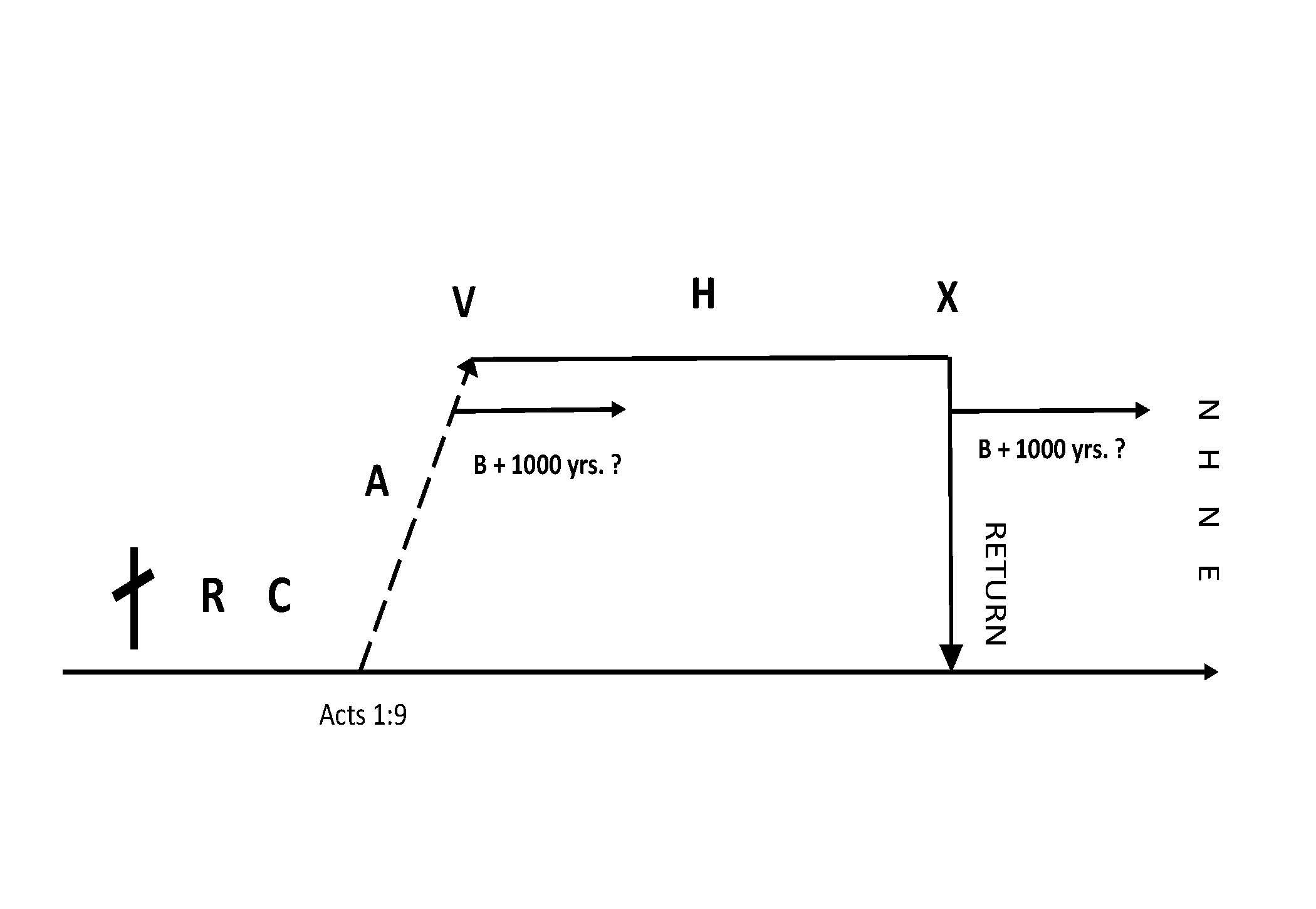
Our final chart is shown below.

               BASIC TIMELINE: CHRIST TO NEW HEAVENS NEW EARTH                                                                                                                                                                                   

  • R = resurrection of Christ
  • C = Christ commissions His church (Matt. 28:18-20)
  • A = Christ’s ascension from earth (Acts 1:9)
  • B = binding of Satan (the dragon) in the abyss (Rev. 20:2-3)
  • V = Christ’s arrival in heaven (Rev. 5:6)
  • H = Christ’s reign at the Father’s right hand (Psalm 110:1; Heb. 10:12-13)
  • X = Christ’s coming (παρουσία) (1 Thess. 4:15-17; Rev. 19:11-21)
  • S = resurrection of the saints (1 Th. 4:15-17; 1 Cor. 15:23, 52)
  • NHNE = new heaven and new earth (Rev. 21-22)

CONCLUSION

QUESTION: When does “the thousand years” occur?

ANSWER: “The thousand years” began ca. AD 30 when Jesus bound Satan in the abyss and will continue until Satan is released for a short time.

Soli Deo gloria            rmb                 9/12/2023                   #670

Resurrection lessons from 1 Corinthians 15 (Part 3)

POST OVERVIEW. The third of a three-part study of 1 Corinthians 15, the great chapter on the Resurrection of the righteous that will occur on the last day. (See Post #648, 5/8/2023 and #649, 5/11/2023, for the first two parts of this study.) The objective of this series of posts is to give the Bible student a firm grasp of the doctrine of the Resurrection.

The previous post in this series (#649, 5/11/2023) finished with the “problem” presented by Paul at the end of 15:50; namely, that no believer in Christ who has a natural, earthly body, whether alive or dead, can inherit the kingdom of God. How, then, does a believer inherit the kingdom of God?

15:51. The solution to the problem is that, in the Resurrection, all believers will receive a glorified body that can inherit the kingdom of heaven.

PAUL’S “MYSTERY” OF THE RESURRECTION

KEY CONCEPT. In this verse, Paul “tells us a mystery.” In the New Testament, a “mystery” is an event or a detail that is currently unknown but that is certain to be revealed in the future. So here, the mystery that is yet to be revealed will explain what happens to those who are still alive when the Resurrection occurs.

THE DEAD ARE RAISED

Here is what I mean. Up to this point in 1 Corinthians 15, Paul has only been talking about believers who are dead in Christ when the Resurrection occurs (e.g., 15:42). We also note that the Bible’s supreme example of resurrection, the raising of Jesus Christ from the dead, was obviously a raising from the dead. Thus, by the undeniable fact of Jesus’ resurrection from the dead as “first fruits” (15:23), we can understand how the dead in Christ would likewise be raised from the dead at the final Resurrection. As Jesus was raised from the dead with a glorified body, so the dead in Christ will also be raised from the dead with glorified bodies. We can readily grasp this analogy.

It is also interesting that other prominent biblical pictures of the Resurrection are pictures of saints who are raised from the dead. In Isaiah 26:19, we see a picture of the Resurrection as “Your dead will live, their corpses will rise.” Isaiah gives us a picture of the dead being raised. In Ezekiel 37, the prophet is “in the middle of a valley and it was full of bones. Behold, there were very many bones on the surface of the ground, and very dry” (37:2). But then the Lord GOD says, “Behold, I will open your graves and cause you to come up out of your graves” (37:12). This is obviously a vision of God raising His people from the dead. When Jesus speaks of the Resurrection in the gospel of John (5:28-29), He says, “An hour is coming when all who are in the tombs will hear His voice (the Son of Man), and (all) will come forth.” Jesus is speaking about the dead being raised in the Resurrection. All these are pictures of those who are dead in Christ being raised from the dead on the last day.

But what about those who are still alive when the Resurrection occurs? We have no solid example from Scripture or analogy from nature that pictures this. How can those “who are alive and remain until the coming of the Lord” (1 Thess. 4:15) be raised from the dead in the Resurrection? It doesn’t seem to make sense. And so this is the “mystery” that Paul is going to discuss. To repeat the question from above, “What happens to those who are still alive when the Resurrection occurs?”

To answer this question, two things are required. First, we must remember the biblical definition of Resurrection. As we have already seen, it is common for believers to mistakenly think of resurrection only in terms of “being raised from the dead” because Jesus was raised from the dead in His resurrection (see above), but the biblical definition of Resurrection is “the receiving of our glorified bodies.” Being glorified is the primary event of the Resurrection, and both those who are dead in Christ and those who are alive are guaranteed to receive their “spiritual body” (15:44). So first, remember what you have already learned.

But second, we must read our Bible carefully and thoughtfully to understand what Paul is teaching. Paul has told us he is going to be teaching us about a mystery. Therefore, our attitude in reading these verses is to understand exactly what the apostle is telling us about the resurrection of those in Christ who are alive on the last day. Except for what is revealed to us in the Scriptures, we are wholly ignorant of this subject. We are “strangers on the earth” (Psalm 119:19), therefore we come to the Scriptures humbly to gain knowledge and understanding. What, then, does Paul teach us here about those who are alive at the Resurrection?

 Paul announces the mystery: “we will not all sleep,” which simply means that not all believers will physically die before they are resurrected. Some believers will sleep, but some will be physically alive at the Resurrection. (see 1 Thess. 4:15-17). But all believers, whether asleep or alive, will receive a glorified body because “we will all be changed.”

15:52. Paul gives a number of details of the Resurrection in this verse.

The Resurrection (“the change”) will be instantaneous, for it will happen “in the twinkling of an eye.”

The Resurrection will occur when the last trumpet sounds (see “trumpet” in Isa. 27:13, “in that day;” Matt. 24:31; 1 Thess. 4:16). 

“The dead will be raised imperishable, and we will be changed.” The dead in Christ (the “perishable”) are raised with glorified (“imperishable”) bodies, and those who are alive (“flesh and blood,” 15:50) are instantly glorified (“changed”). (This latter occurrence is the mystery.)

Note that this description of the Resurrection is in perfect agreement with what Paul writes in 1 Thess. 4:16-17. The dead in Christ are raised and glorified and those who are alive in Christ are changed and glorified. (See also Isaiah 26:19; Phil. 3:20-21; 1 John 3:2.)

It is also important to note that, although Paul does not mention Christ’s coming (παρουσία) in this passage, the Scriptures make plain that the Resurrection occurs simultaneously with Jesus’ coming. From the lips of Jesus Himself, we also know that these events of the Resurrection occur on the last day (John 6:39, 40, 44, 54).

15:53. We know that “this perishable” refers to those who are dead in Christ (15:42, 52). What must occur for them? “This perishable must put on the imperishable.” The “imperishable” refers to the glorified body (15:42). The dead in Christ must put on their glorified bodies.

The Greek word for “must” is δεῖ, which can be translated “is (absolutely) necessary,” “is inevitable,” or “must.” What is being communicated here is that the only way that “the perishable” (those who are dead in Christ) can inherit the kingdom of God (see 15:50) is for them to “put on the imperishable.” For them to be fit for eternity in heaven, the dead in Christ must receive their glorified body. There is no other way.

Likewise, “this mortal must put on immortality.” “Mortal” here refers to those who are still subject to death, which is those who are still alive. The only way that “the mortal” can inherit the kingdom of God (see 15:50) is for them to “put on immortality.” For them to be fit for eternity in heaven, they must receive their glorified body. There is no other way.

15:54. When all the dead in Christ are raised in their imperishable glorified bodies, and when all those who are alive in Christ have been quickly changed into their immortal glorified bodies, then death will have been swallowed up in victory. All “those who are Christ’s at His coming” (1 Cor 15:23) will have donned their eternal glorified bodies and death will have been forever defeated.

SUMMARY

We should take a moment after this study to summarize what we have learned, for we have received strong teaching about the doctrine of the Resurrection from 1 Corinthians 15.

  • The Resurrection of all the righteous will occur on the last day (15:23-24).
  • The Resurrection occurs at the same time that the Lord Jesus descends from heaven. So it includes all “those who are Christ’s at His coming” (15:23).
  • The Resurrection speaks primarily about the event when those who are in Christ receive their glorified bodies.
  • All those who are in Christ are guaranteed to receive a glorified body at the Resurrection (15:44, 49).
  • The Resurrection will include the glorification of all the “dead in Christ” and all those who are “alive and remain.”
  • The Resurrection will be instantaneous (15:52).
  • The Resurrection will occur at the sounding of the last trumpet (15:52).

Finally, it is important to remember that, although we have discovered these doctrinal truths by carefully studying 1 Corinthians 15, the truths we have discovered are universal truths. That is, the doctrinal truths about the Resurrection discovered in 1 Corinthians 15 are true for the Resurrection wherever it is mentioned in the Bible. So there is not the doctrine of the Resurrection according to Paul in 1 Corinthians 15 and a different set of doctrines in Isaiah or in the gospel of John or in 1 Thessalonians. The events of the Resurrection as described in 1 Corinthians 15 must agree with the events surrounding the Resurrection in the other passages in Scripture because the Holy Spirit is the author of all Scripture (2 Timothy 3:16) and He does not contradict Himself. Other Scriptural passages about the Resurrection may add new details or may present the truths with other word pictures, but other Scripture cannot present a different Resurrection. An interpretation of the Resurrection that conflicts with the one taught in 1 Corinthians 15 should be replaced with the one taught in the Scriptures.

Soli Deo gloria            rmb                 5/15/2023                   #650

Resurrection lessons from 1 Corinthians 15 (Part 2)

POST OVERVIEW. The second of a three-part study of 1 Corinthians 15, the great chapter on the Resurrection of the righteous that will occur on the last day. (See Post #648, 5/8/2023, for the first part of this study.) The objective of this series of posts is to give the Bible student a firm grasp of the doctrine of the Resurrection.

In the first part of this study of 1 Corinthians 15 (post #648, 5/8/2023), we had established some basic understandings of the Resurrection. First, when we use the word “Resurrection,” we are referring to the general resurrection of all the righteous that will occur on the last day (John 6:39, 40, 44, 54; 11:24) at the same time that the Lord Jesus descends from heaven with a shout (1 Thess. 4:16). Also, although there are several events that occur in the Resurrection, the primary and defining event is that all the righteous of all time will receive their eternal glorified bodies.

We were in the process of examining the meaning of 1 Cor. 15:42-44, and now we continue that examination by looking at 15:44. In this section, Paul is comparing the physical body that we are given for our earthly life with the heavenly body that we will be given in the Resurrection, particularly in relation to the physical body when it has died. Paul uses the word picture of a seed that is sown into the ground to describe our physical body when it is finally “sown” into the grave.

44 it is sown a natural body; it is raised a spiritual body. If there is a natural body, there is also a spiritual body.

15:44. At our death, our natural body is sown into the ground, having lost all its usefulness. All the parts of the body are there, but there is a complete absence of life. The purpose of the natural body was to carry us and be our servant from birth to death, but now that death has come, the purpose of our natural body has gone and thus it is thrown into the ground.

But the resurrection body, our “spiritual” body, is not like that. We will be raised with a spiritual body that is completely unlike the natural body that went into the grave. Our spiritual body will be useful to us throughout all of eternity. The purpose of this spiritual body is to allow us to serve and worship the King of kings in sinless joy forever, and that purpose will never change or become obsolete.

And Paul punctuates this verse with a promise, that if the believer in Jesus had a natural body, then there will certainly be for that believer a spiritual body. In other words, every believer is promised a glorified spiritual body that will allow them “to stand before the throne and before the Lamb, clothed in white robes (indicating that our glorified bodies will be clothed in heaven), and palm branches in their hands, crying out with a loud voice, saying ‘Salvation to our God who sits on the throne, and to the Lamb’” (Rev. 7:9-10).

This amazing chapter culminates in 15:50-54 with more teaching about the Resurrection as the apostle tells us about the actual event itself. The inspiration of the Holy Spirit is evident in this passage as we see that this description of the Resurrection is in complete agreement with other Scriptures about this event.

50 Now I say this, brethren, that flesh and blood cannot inherit the kingdom of God; nor does the perishable inherit the imperishable. 51 Behold, I tell you a mystery; we will not all sleep, but we will all be changed, 52 in a moment, in the twinkling of an eye, at the last trumpet; for the trumpet will sound, and the dead will be raised imperishable, and we will be changed. 53 For this perishable must put on the imperishable, and this mortal must put on immortality. 54 But when this perishable will have put on the imperishable, and this mortal will have put on immortality, then will come about the saying that is written, “Death is swallowed up in victory.

In this five-verse theological masterpiece, we will see that, in each verse in this passage, Paul addresses both those who are asleep (“the dead in Christ”) and “those who are alive and remain until the coming (παρουσία) of the Lord” (1 Thess. 4:15). This is significant because it tells us that all those who are in Christ at the Lord’s return will be resurrected to receive their glorified bodies.  

EXEGETICAL NOTE: Paul consistently uses the words “perishable” and “imperishable” to refer to those who are dead in Christ at the Resurrection. Since this is the case, we can use “dead in Christ” and “perishable” interchangeably.

15:50. Paul says that those who have “flesh-and-blood” bodies at the Resurrection are completely unprepared for eternal life in the kingdom of God. In other words, those who are physically alive in Christ “cannot inherit the kingdom of God.” But Paul adds that “the perishable,” those who are physically dead in Christ (15:42), also “cannot inherit the kingdom of God.” Paul has thus presented a problem; namely, that no believer in Christ who has a natural, earthly, physical body, whether alive or dead, can inherit the kingdom of God. What is the solution to this problem?  

We will explore the answer to this question in the next post in this series, and we will also solve Paul’s “mystery” from 1 Corinthians 15:51. Go to Post #650 for more teaching on the Resurrection.

Soli Deo gloria            rmb                 5/11/2023                   #649

Resurrection lessons from 1 Corinthians 15 (Part 1)

POST OVERVIEW. The first of a two-part study of 1 Corinthians 15, the great chapter on the Resurrection of the righteous that will occur on the last day.

The apostle Paul expresses some of his clearest doctrinal teaching about the Resurrection in 1 Corinthians 15. A correct understanding of Paul’s teaching here allows the student of eschatology to avoid many of the most common end-times errors and instead to see the consistency of the Holy Spirit-inspired Scriptures. This article will explore 1 Corinthians 15 and identify key points in the doctrine of the Resurrection.

DEFINITION OF RESURRECTION

Before we begin our investigation, we need to define our terms. When we use the word “Resurrection,” we are referring to the general resurrection of all the righteous that will occur on the last day (John 6:39, 40, 44, 54; 11:24). There are several events that characterize the Resurrection. First, Jesus Himself is the One who “will raise up” the righteous (again, John 6:39, etc.). The Resurrection occurs at the same time that the Lord Jesus descends from heaven with a shout (1 Thess. 4:16). The Resurrection includes both all those who are dead in Christ at His coming (παρουσία) and all those in Christ who are alive at His coming (1 Thess. 4:15-17).

THE PRIMARY MEANING OF “RESURRECTION”

The primary event in the Resurrection is that all the righteous of all time receive their eternal glorified bodies. Technically, “resurrection,” as used in reference to the general resurrection, does not mean merely rising from the dead (for those who are living will also be resurrected), but means “being glorified.” In the Resurrection, then, all the righteous of all time are glorified. Much of the teaching about our glorification comes from the chapter we are studying, namely 1 Corinthians 15.

Now that we have established the meaning of Resurrection, we will dig into select verses from 1 Corinthians 15.

23 But each in his own order: Christ the first fruits, after that those who are Christ’s at His coming, 24 Then comes the end. . .

Paul is writing about the order of the resurrection. He has begun his teaching in this chapter by establishing the fact of the general resurrection from the fact that Jesus was resurrected from the dead. Jesus’ resurrection is an indisputable, undeniable fact, and since Jesus Christ has been raised from the dead, we know that we also will be resurrected.

“But what will be the timing of our resurrection?”

First, Paul describes Jesus’ resurrection as the “first fruits of those who are asleep” (see 15:20, also). “First fruits” was a term from the Old Testament which devoted the best of the harvest to the Lord and which also anticipated that the full harvest was certainly coming in. So here, Christ is the first and the best of those who will be resurrected and His resurrection guarantees that all His people will also be resurrected.

When will they be resurrected? In complete agreement with other Scriptures (see above), the Resurrection of all those who are Christ’s will occur at His coming (παρουσία) on the last day and will occur just before the end. Whether alive or “asleep,” all the righteous will rise glorified to meet their King as He descends with a shout to judge the earth. And then comes the end.

Thus from 15:23 we learn that 1) Christ’s resurrection guarantees the resurrection of all those who are in Christ; 2) the general Resurrection occurs at Jesus’ coming (παρουσία) 3) on the last day; 4) the end immediately follows.

42 So also is the resurrection of the dead. It is sown a perishable body, it is raised an imperishable body43 it is sown in dishonor, it is raised in glory; it is sown in weakness, it is raised in power; 44 it is sown a natural body, it is raised a spiritual body. If there is a natural body, there is also a spiritual body.

The apostle now goes on to explain the difference between our natural body and our glorified resurrection body. He is answering the rhetorical question asked in 15:35, “And with what kind of body do they come?”

15:42. First, he says, we go into the ground “in corruption.” This is the literal translation of the Greek. Anyone who has seen a dead body understands what Paul is saying. The dead physical body is no longer of any use and lies motionless and cold, but it will soon be “sown” into the ground where it will gradually decompose and return to dust (Gen. 3:19). Thus it is sown in corruption.

But the resurrection body is not like that. When we are raised, we will be given glorified bodies that will never see corruption or decay (Psalm 16:10b).

15:43a. We go into the ground “in dishonor.” There was a time when our body was young and supple and strong and we proudly walked on the beach in our bathing suit. But the natural body does not bear the test of time, and soon we are stooped and stiff and saggy. Then finally we enter the ground in complete humiliation. All beauty is gone from our earthly body.

But the resurrection body is not like that. The resurrection body will be revealed in dazzling glory (Phil. 3:21). Our resurrection body will be like the glorified body of Jesus (1 John 3:2), whose glory is so powerful that just a momentary glimpse blinded Saul the Pharisee for three days (Acts 9:3-9). So will our bodies be, unimaginably beautiful and sinless and perfect.

15:43b. We go into the ground “in weakness.” There is nothing so weak and useless as a dead body. At the instant of death, all remaining strength vanishes. If standing, the body collapses to the ground. If lying down, all muscles immediately go limp. The earthly body that goes into the ground is the supreme example of weakness.

But the resurrection body is not like that. Our resurrection body will be marked with power, and that power will never diminish. We will have, in our glorified bodies, the power to do whatever works we are called to do throughout eternity with never a trace of fatigue.

We have more to learn about the Resurrection from the apostle Paul. Our study of this chapter will continue in the next post.

Soli Deo gloria            rmb                 5/8/2023                     #648

Studies from John 6 – When is Jesus coming?

POST OVERVIEW. A Bible study based on the teaching of John 6 intended to determine when the coming of the Lord occurs.

OBJECTIVE: The objective of this study in the Scriptures is to determine when the coming of the Lord occurs. This could also be the question, “When will Jesus be revealed?” or “When will the appearing of the Lord occur?”

FROM JOHN 6. We will begin with Jesus’ teaching in John 6 and asking the question,

“According to Jesus, when does the Resurrection occur?”

39  “This is the will of Him who sent Me, that of all that He has given Me I lose nothing but raise it up on the last day.” Jesus is speaking about those who will be saved. He will raise them up on the last day.

40 ”For this is the will of My Father, that everyone who beholds the Son and believes in Him will have eternal life, and I Myself will raise him up on the last day.” Jesus Himself will resurrect all believers on the last day.

44 ”No one can come to Me unless the Father who sent Me draws him; and I will raise him up on the last day.” Jesus will raise up on the last day all whom the Father draws.

 54 ”He who eats My flesh and drinks My blood has eternal life, and I will raise him up on the last day.” Once again, Jesus will raise them up on the last day.

A final reference will be from John 11:24.

24 Martha *said to Him, “I know that he will rise again in the resurrection on the last day.” In this conversation between the Lord and Martha about Lazarus, Martha knows that Lazarus will rise on the last day.

Based on five unambiguous verses from the gospel of John, we can say with complete confidence that:

The Bible teaches that the Resurrection occurs on the last day.

This now becomes a doctrinal truth for all other Bible study.

(NOTE: “The Resurrection” is defined as the event when God’s people receive their glorified, resurrection bodies. Thus, the Resurrection is the believer’s glorification.)

But our OBJECTIVE as stated above was to discover when the coming of the Lord occurs according to the Scriptures. Why start with when the Resurrection occurs? It is because the timing of the Resurrection and the timing of the coming of the Lord are related.

The Bible also teaches that the coming (παρουσία) of Jesus occurs at the same time as the Resurrection of the saints.

SCRIPTURAL PROOF

FROM COLOSSIANS 3:4. “When Christ, who is our life, is revealed, then you also will be revealed with Him in glory.”

The verse tells of the future time when “Christ is revealed,” which certainly speaks of the coming of the Lord in glory. Note that, at that time, “(we) also will be revealed with Him in glory.” Christ is revealed in glory at the same time that we are revealed with Him in glory. The coming of the Lord and the Resurrection occur at the same time.

FROM PHIL. 3:21.  Christ “will transform the body of our humble state into conformity with the body of His glory.” Jesus will transform us into glorified saints. Our bodies will be conformed to His glory. When will this occur? When He is revealed in glory, of course. Thus this verse teaches that we will be transformed at the time when Jesus is revealed.

FROM 1 JOHN 3:2. “We know that when He appears, we will be like Him.” In this verse, John says what Paul has said in Colossians and Philippians. When Christ appears, He will be coming in blazing glory. And John says, “We will be like Him.” This must mean that we are going to be glorified (resurrected) when Christ comes. In other words, His coming and our Resurrection occur at the same time.

FROM 1 THESS. 4:15-17. This section of 1 Thess. is explicitly about the timing of the Resurrection. In these three verses, Paul unambiguously teaches how the coming of Christ relates to the Resurrection of the saints. We will quote the whole passage.

15 For this we say to you by the word of the Lord, that we who are alive and remain until the coming of the Lord, will not precede those who have fallen asleep. 16 For the Lord Himself will descend from heaven with a shout, with the voice of the archangel and with the trumpet of God, and the dead in Christ will rise first. 17 Then we who are alive and remain will be caught up together with them in the clouds to meet the Lord in the air, and so we shall always be with the Lord.

The apostle gives the details of the “coming of the Lord,” and he also supplies the order of the Resurrection. At “the coming of the Lord” or when “the Lord Himself will descend from heaven,” the Resurrection of the saints will occur. Saints who have “fallen asleep” (“the dead in Christ”) will be resurrected first, then saints who are still alive will be resurrected next. Then the resurrected saints will meet the descending Lord Jesus in the air. In the clearest possible words, Paul says that the coming of the Lord happens at the same time as the Resurrection of the saints.

[FURTHER NOTES: There can be some confusion about what happens after the glorified saints “meet the Lord in the air” (4:17), but the Bible is not unclear about this. See my teaching on this in Post #625 from February 22, 2023.]

Now, since the Bible teaches that the Resurrection occurs on the last day, and since we have shown that coming of the Lord occurs on the same day as the Resurrection of the saints, we can state as a doctrinal truth that the coming of the Lord occurs on the last day.

The Bible teaches that the coming of the Lord occurs on the last day.

IMPLICATIONS: In the course of this study, we have established two doctrinal truths. First, the Resurrection of the saints occurs on the last day, and second, the coming of the Lord occurs on the last day. Our next post will consider some of the implications of these truths.

Soli Deo gloria            rmb                 2/22/2023                   #626