The thousand years: Part 2 – When does Jesus bind Satan?

POST OVERVIEW. The second in a series of studies of Revelation 20:1-3 seeking to determine when “the thousand years” occur. This specific study attempts to determine when Jesus binds Satan in the abyss (Rev. 20:2-3). (See also post #668, 9/10/2023.)

REVIEW

This article is the second in a series of studies focused on Revelation 20:1-3 whose objective is to determine when, in human history, “the thousand years” (“the MILL”) occurs. In our first study (Post #668, 9/10/2023), we discovered the following:

  • “The dragon” represents Satan (20:2). (Thus, whenever we encounter “the dragon” in Revelation, we know that we have encountered Satan.)
  • “The angel” (20:1) represents the Lord Jesus.
  • The MILL begins when the Lord Jesus binds Satan and throws him into the abyss.
  • At the end of the MILL, Satan is released from the abyss for a short time.

This second study is intended to begin to answer the crucial question, “WHEN does Jesus bind Satan in the abyss?”

As we consider this question and review the passage in Revelation 20:1-3, it may at first appear that we have reached a cul-de-sac. It may seem that there is no way to figure out when Jesus binds Satan in the abyss at the beginning of the MILL. Where do we go from here?

JESUS BINDS SATAN. First, there is significance in the fact that it is Jesus who binds Satan in the abyss. Jesus is King of kings and Lord of lords and He reigns over heaven and earth, but He, as the God-Man, can only be in one place at a time. This fact will help us as we explore the question of when Jesus binds Satan.

Thinking broadly, one thing we can say for certain is that Jesus’ binding of Satan takes place after His resurrection and subsequent ascension to heaven (Acts 1:9) and before the inauguration of the new heaven and the new earth (Rev. 21:1). We also know with certainty that, at some point in time, Jesus is coming from heaven to judge the earth. Those realities are illustrated in the figure below.

  BASIC TIMELINE: CHRIST TO NEW HEAVENS NEW EARTH

  • R = resurrection of Christ
  • C = Christ commissions His church (Matt. 28:18-20)
  • A = Christ’s ascension (Acts 1:9)
  • V = Christ’s arrival in heaven (Revelation 5:6)
  • X = Christ’s coming (παρουσία) (Revelation 19:11-21)
  • NHNE = new heavens and the new earth (Rev. 21-22)

Next, recalling that Jesus as God-Man can only be in one place at a time (see above), we will refine our crucial question and ask, “WHEN could Jesus bind Satan in the abyss?” Our study of the Scriptures will reveal that there are only two times when it is possible for Jesus to bind Satan in the abyss.

As we prepare to expand our study to the books outside of Revelation, it is appropriate to remind ourselves of the nature of this amazing Bible that we hold in our hands.

THE POWER AND BEAUTY OF THE SCRIPTURES

The beauty of the Bible is that each of its 66 books has been inspired by the same Author, the Holy Spirit. Because all Scripture is God-breathed (2 Tim. 3:16), the Bible is both interconnected and consistent.

It is interconnected in that each book of the Bible fits together with the other books to form a cohesive whole. Just as each piece of a jigsaw puzzle is necessary to complete the whole puzzle, so the books of the Bible connect with each other to form the whole message of God to man. Because this is the case, we can allow Scripture to interpret Scripture as one portion of the Word illumines and informs another portion.

And the Bible is consistent in that there is no contradiction between the individual books, but instead there is a God-breathed harmony. Despite including writings of poetry and prophecy, narrative history and Mosaic Law, gospels and epistles and apocalypse, the themes and doctrines pictured throughout the Bible do not contradict or conflict with one another but rather reinforce and complement one another. This means that the better we know our Bibles, the more confident we become about its power to guide us into all truth.

In 2 Tim. 2:15, Paul exhorts Timothy, “Be diligent to present yourself approved to God as a workman who does not need to be ashamed, accurately handling the word of truth.” Confident of the power of the Scriptures, we are now going to accurately handle the word of truth and go to other Scriptures outside of Revelation to answer these crucial questions.

FROM REVELATION 20 TO PSALM 110

For this part of our study we will leave Revelation 20 and turn to Psalm 110. This psalm is both Messianic and eschatological and will teach us about Christ’s reign after His ascension to heaven. We will focus our attention on Psalm 110:1.

The Lord says to my Lord:
“Sit at My right hand
Until I make Your enemies a footstool for Your feet.” – Psalm 110:1

Here in Psalm 110:1 we see one Person of the Godhead (the LORD) speaking to another Person of the Godhead (the Lord). The conversation is between God the Father and God the Son, and the nature of the conversation reveals the occasion of this verse. This verse takes place after Jesus has accomplished His work of atonement on the cross (John 19:30, etc.), has been raised from the dead, and has ascended back to heaven. Now (ca. AD 30) the Father welcomes the victorious Son back to heaven and seats Jesus in the place of honor at the Father’s right hand until the time comes for Jesus to return to earth for the Judgment (“make Your enemies a footstool”). So, according to Psalm 110:1, from the time of Jesus’ return to heaven until His coming to earth in judgment, He is seated at the Father’s right hand in heaven.

Other verses in Scripture confirm this reality. In Ephesians 1:20, Paul tells us that “the Father raised Him (Jesus) from the dead and seated Him at His right hand in the heavenly places.” Hebrews 1:3 says, “When He had made purification of sins (the cross), He sat down at the right hand of the Majesty on high.” The same point is made in Hebrews 8:1 and 12:2, but the clearest expression of this is in Hebrews 10:12-13:

12 but He, having offered one sacrifice for sins for all time, sat down at the right hand of God, 13 waiting from that time onward until His enemies be made a footstool for His feet.

The time when “His enemies (will) be made a footstool for His feet” refers to the time when Christ will rise from His seat at the Father’s right hand and will come back to earth to judge the unrighteous. These Scriptures teach us that:

  • Jesus is seated at the Father’s right hand from the time He ascended to heaven (ca. AD 30) until He returns to earth for the Judgment.

We are going to add this new discovery to our chart. (See below.)
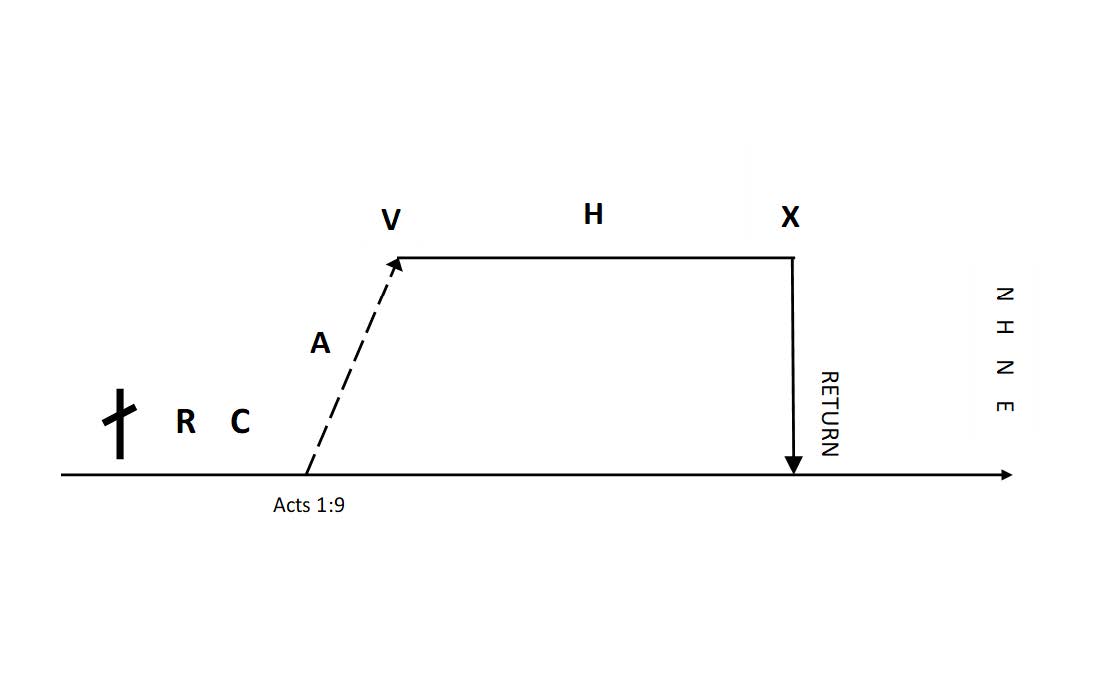
BASIC TIMELINE: CHRIST TO NEW HEAVENS NEW EARTH

  • R = resurrection of Christ
  • C = Christ commissions His church (Matt. 28:18-20)
  • A = Christ’s ascension (Acts 1:9)
  • V = Christ’s arrival in heaven (Revelation 5:6)
  • H = Christ’s reign at Father’s right hand (Ps. 110:1; Heb. 10:12-13)
  • X = Christ’s coming (παρουσία) (Rev. 19:11-21)
  • NHNE = new heavens and the new earth (Rev. 21-22)

Thus we can logically say that, while Jesus is seated at the Father’s right hand (H) in heaven, He cannot at the same time bind Satan in the abyss. In other words, the event of Jesus binding Satan in the abyss cannot take place between the time of Jesus’ arrival in heaven (V – Rev. 5:6) and His coming to earth as Judge (X – Rev. 19:11-21; etc.) because He is seated at the Father’s right hand.

Since that is the case, we can see from our chart that there are only two times when Jesus could bind Satan in the abyss. The first possibility would be after His return (His παρουσία), and the second possibility would be for Him to bind Satan while He is ascending to heaven between Acts 1:9 and Rev. 5:6ff. And this is the answer to the crucial question we asked above about WHEN Jesus could bind Satan in the abyss. These possibilities are illustrated in the figure below. (“B” stands for “binding.”)

The question is, “How do we decide between these two possibilities?” That will be the subject of our next study.

Soli Deo gloria            rmb                 9/11/2023                   #669

When does “the thousand years” occur? Part 1 – Who is the angel?

POST OVERVIEW. The first in a series of studies of Revelation 20:1-3 seeking to determine when “the thousand years” occur. This specific study seeks to determine the identity of the angel in Revelation 20:1.

INTRODUCTION

Some of the most controversial questions concerning the book of Revelation revolve around the subject of “the thousand years” in Rev. 20:1-7. The purpose of this series of studies is to determine when “the thousand years” occurs in human history. The outcome that we seek is a graphical representation of where “the thousand years” fits on the timeline between the crucifixion and resurrection of Jesus Christ (ca. AD 30) on the one end and the inauguration of the new heaven and the new earth (Rev. 21:1) on the other.

PRELIMINARIES

PASSAGE FOR STUDY. Despite the immense attention and emphasis that accrues to “the thousand years,” the only explicit mention of this time period in the Bible is in the six verses of Rev. 20:2-7. But because we are seeking the answer to a very specific question (“When do the thousand years occur?”), we will further limit the focus of these studies to Revelation 20:1-3 when the angel throws the dragon into the abyss for “the thousand years.”

In any of these studies in Revelation 5-20, it is assumed that the reader has previously read my article, “Basic interpretive principles for Rev. 5-20.” [APOLOGIES: As of the publishing of this blog post, this article was still in progress.] This article explains the basis for the two key interpretive principles for Rev. 5-20 and also presents two crucial questions which are very useful for understanding these difficult passages.

TWO KEY PRINCIPLES AND TWO CRUCIAL QUESTIONS. Stated briefly, the two key principles are 1) Rev. 5-20 is not written in chronological order, and 2) our default assumption is that the characters and events of Rev. 5-20 are to be understood figuratively or symbolically, not literally. Since Revelation is not written chronologically, we must persistently ask the crucial question, “WHEN does this event occur?” And because Revelation is characterized by symbolism, we must often ask the crucial question, “WHO OR WHAT does this symbol represent?” As we progress through this study in Revelation 20, we will see the power and the usefulness of skillfully asking and answering these two crucial questions.

DEFINITION OF THE “THOUSAND YEARS.” In these studies, we are treating “the thousand years” as a label for a long period of time rather than as a literal thousand years. In the book of Revelation, certain numbers have symbolic meaning. “One thousand” is one of those symbolic numbers. When John wrote Revelation, “one thousand” simply meant a very large number, and so “a thousand years” should be understood simply as a very long period of time.

SUBSTITUTE “THE MILL” FOR “THE THOUSAND YEARS.” Since we are treating “the thousand years” as a single block of time, I am inventing the singular noun “the MILL” to represent “the thousand years.” This substitution is done to avoid confusion about whether “the thousand years” is singular or plural.

Finally, unless otherwise noted, my text is the New American Standard Bible (1995).

THE STUDY: WHEN DOES ‘THE THOUSAND YEARS’ OCCUR?

Part 1: Who is the angel in Rev. 20:1?

Then I saw an angel coming down from heaven, holding the key of the abyss and a great chain in his hand. And he laid hold of the dragon, the serpent of old, who is the devil and Satan, and bound him for a thousand years; and he threw him into the abyss, and shut it and sealed it over him, so that he would not deceive the nations any longer, until the thousand years were completed; after these things he must be released for a short time. – Revelation 20:1-3

While the overall objective of this series of studies is to determine from the Scriptures when “the MILL” occurs on the timeline of end-times events, this first study is aimed at determining the identity of the angel mentioned in this passage.

We will begin by surveying the text to see what information these verses provide. First, we see two characters, an angel and the dragon. The dragon is clearly identified as Satan (20:2). Then we see the angel “laid hold of the dragon (Satan) and bound him for a MILL; and he threw him into the abyss and shut it and sealed it over him until the MILL was completed; after these things he (Satan) must be released for a short time.” From this we can say that the MILL begins when an angel grabs Satan and throws him into the abyss for the duration of the MILL. We also see that, at the end of the MILL, Satan must be released for a short time. So far, we know that:

  • The dragon represents Satan. (Thus, whenever we encounter “the dragon” in Revelation, we know that we have encountered Satan.)
  • The MILL begins when an angel binds Satan and throws him into the abyss.
  • At the end of the MILL, Satan is released from the abyss for a short time.

So now we know who the dragon represents, but we do not yet know who the angel represents. Therefore, we ask a crucial question. “WHO does this angel represent?”

THE ANGEL. Let’s examine what we know about this angel.

The angel is “coming down from heaven.” This is the identical phrase that we read in Rev. 10:1 (“another angel coming down out of heaven”) and “the angel” of Rev. 10 is certainly the glorious Lord Jesus. Thus, this may be a clue that this angel is also Jesus.

We also read that this “angel” has the key of the abyss in his hand. In Revelation, the one who controls all the keys is Jesus, for we read in Rev. 1:18, “I (Jesus) have the keys of death and Hades.” Just so, Jesus is the one who controls the key of the abyss. And here this “angel” has the key of the abyss. Another clue!

Thirdly, we see that the angel “laid hold of Satan and threw him into the abyss” (20:2-3). This cannot be an ordinary angel, because Satan is “the anointed cherub” of Ezekiel 28:14 and is the most powerful of all the angels. In Jude 9, even Michael the archangel did not dare pronounce a judgment against the devil, but said, “The Lord rebuke you.” But if Satan is more powerful than even archangels, we must ask the question, “Who, then, is this ‘angel’ who grabs Satan like a ragdoll and then throws him and shuts him and seals him in the abyss?” The answer is obvious: The “angel” of Rev. 20:1-3 can only be the glorious Lord Jesus Himself. He is the One who descends from heaven to deal with Satan and He is the One who holds the key to the abyss and He is the only one with the authority to completely overwhelm and subdue Satan. We conclude, then, that “the angel” of Rev. 20:1-3 is a symbol for the Lord Jesus.

  • The “angel” of Rev. 20:1-3 is Jesus and the event that begins the MILL is when Jesus binds Satan in the abyss for the duration of the MILL.

CONCLUSION. In this first study of Rev. 20:1-3, we have gathered these facts.

  • “The dragon” represents Satan. (Thus, whenever we encounter “the dragon” in Revelation, we know that we have encountered Satan.)
  • “The angel” in verse 1 represents the Lord Jesus.
  • The MILL begins when the Lord Jesus binds Satan and throws him into the abyss.
  • At the end of the MILL, Satan is released from the abyss for a short time.

Knowing that the MILL begins with Jesus binding Satan in the abyss, our next study will attempt to answer another crucial question, “WHEN does Jesus bind Satan in the abyss?”

Soli Deo gloria            rmb                 9/10/2023                   #668

There is only one “beast” in Revelation

POST OVERVIEW. An article for my upcoming book on Revelation that demonstrates that, despite the various appearances of “the beast” in the latter half of Revelation, there is only one beast. Everywhere that “the beast” appears, he is the same beast.

ONLY ONE BEAST IN REVELATION

One of the most intriguing characters in the book of Revelation is “the beast,” who plays a major role in the unfolding events of the 42 months at the very end of the age. “The beast” is the final and most vivid of the seven manifestations of the antichrist in the Bible and, because many people have studied Revelation, “the beast” is also the best-known. My upcoming book on Revelation will contain several different articles and studies touching on “the beast,” but this article has only one aim: namely, to demonstrate that, despite the various appearances of “the beast” in the latter half of Revelation, there is only one beast. Everywhere that “the beast” appears, he is the same beast. The following notes make this case.

  • In Rev. 11:7, we encounter “the beast” warring with “the two witnesses.” “The beast that comes up out of the abyss will make war with them (i.e., ‘the two witnesses’) and overcome them and kill them.” The “two witnesses” are symbolic of the faithful church, which courageously “finishes their testimony” (Rev. 11:7). (Note that there are many verses in the New Testament that speak of the church’s duty to witness of Jesus, like Acts 1:8; John 15:27).
  • As Revelation 12 is focused on “the dragon,” so Revelation 13:1-10 is focused on “the beast” and gives us insight into his character, his ambitions, and his activity.
  • In fact, we see displayed in Rev. 12-13 the entire “unholy trinity” of “the dragon” (Satan), “the beast,” and “the false prophet,” who is called “another beast” in Rev. 13:11-17. (This “unholy trinity” appears again in Rev. 16:13-16, 19:19-20, and 20:10.)
  • A comparison of Rev. 13:7 with Rev. 11:7 makes it apparent that these two verses are describing the same “beast.” (See “only one beast” above.)
  • IMPORTANT INTERPRETIVE NOTE: Not only is it apparent that “the beast” of Rev. 11:7 is the same beast of Rev. 13:7, but it is also logical to conclude that these two verses are describing the same events and, therefore, must be occurring at the same time. That these events take place at the same time is further supported by the fact that the events of Rev. 11:3-10 happen during the 42 months (“twelve hundred and sixty days” in Rev. 11:3) and the events of Rev. 13:5-10 also happen during the 42 months (“forty-two months” in Rev. 13:5).
  • Since Rev. 11:7 is describing the same events as Rev. 13:7, and since in both verses “the beast” is the one who is “making war with and overcoming” his adversaries, we conclude that “the two witnesses” of Rev. 11:7 must also be “the saints” of Rev. 13:7. This supports our earlier statement that “the two witnesses” represent the faithful church under persecution.
  • This means that the events surrounding “the beast’s” persecution of the faithful church in Rev. 11:3-10 are essentially the same events that occur in Rev. 13:5-10, but from a different perspective.
  • The next time “the beast” appears, he is with “the dragon” and “the false prophet” preparing to gather the kings of the earth for Armageddon (Rev. 16:13-16). This is obviously the same beast that we saw in Rev. 13.
  • When we meet “the scarlet beast” in Rev. 17:3, it may initially seem that we have met a new character, but a careful reading of the text of Rev. 17 will reveal that this, too, is “the same beast” we have encountered before.
  • Here are the clues that tell us that “the beast” here is the same beast.
    • He is “full of blasphemous names, having seven heads and ten horns” (17:3). In Rev. 13:1, “the beast” has “ten horns and seven heads, and on his heads were blasphemous names.” This exact agreement between the two descriptions of “the beast” is strong evidence that this is the same beast, but there are more clues.
    • In Rev. 17:8, “the beast” “is about to come up out of the abyss,” but in Rev. 11:7 we read of “‘the beast’ that comes out of the abyss.” Again, the agreement between the two texts removes any doubt that they are the same character. But the clues go on.
    • Still in Rev. 17:8, we read “those who dwell on the earth” (“all who dwell on the earth” 13:8), “whose name has not been written in the book of life from the foundation of the world” (“whose name has not been written from the foundation of the world in the book of life” 13:8). Again we observe intentional repetition of the exact phrases in order to alert the reader to the connection.
    • Finally, we read in Rev. 17:8 that “those who dwell on the earth will wonder” (θαυμασθήσονται, from θαυμάζω (Greek) meaning “wonder” or “be amazed” or “marvel”) “when they see the beast.” But in the parallel verse in Rev. 13:3 we read, “the whole earth was amazed“ (ἐθαυμάσθη, from θαυμάζω (Greek) meaning “wonder” or “be amazed” or “marvel”) “and followed after the beast.” [NOTE: The NASB chooses a different English verb for Rev. 17:8 and Rev. 13:3, but the underlying original Greek uses the same Greek verb to make sure the observant reader sees the connection.]
    • By carefully examining the words and phrases that are used, we are making the point that “the scarlet beast” that we meet in Revelation 17 is “the same beast” that we have already encountered in Revelation 11, 13, and 16. Again, in Revelation, there is only one beast.
  • The last time that we see “the beast” is in Rev. 19:19-20 when he has “assembled the kings of the earth and their armies to make war against Him who sat on the horse and against His army.” This scene takes place during what I call the second half of Armageddon, when the glorified Lord Jesus has returned “with all His (glorified) saints” (1 Thess. 3:13) “to judge the living and the dead” (2 Tim. 4:1) and “to tread the wine press of the fierce wrath of God, the Almighty” (Rev. 19:15). In this hopeless mismatch, the Lord throws “the beast” “into the lake of fire” (19:20).

SUMMARY. By carefully examining the passages where “the beast” appears in Revelation and by comparing the passages with one another we have seen that each appearance of the beast reveals the same personality. The author of Revelation has intentionally placed clues in the text to ensure that his readers connect the clues and see that there is only one beast in Revelation.

Soli Deo gloria            rmb                 8/11/2023                   #667

The binding of Satan, Part 2 (Revelation 20:1-3)

POST OVERVIEW. There are two places in the Bible that teach about the binding of Satan, in Matthew 12:29 and in Revelation 20:1-3. In post #566, we looked at Matthew 12:29. This post will be a study of Revelation 20:1-3.  

Our purpose in these two posts is to discover what the Scripture teaches us about the binding of Satan, implicit in Matthew 12:29 and explicit in Revelation 20:1-3. In post #566, we looked at Matthew 12:29 and discovered that this verse teaches us that Jesus is going to bind Satan so that Satan’s kingdom can be plundered, and that “plundering” will be accomplished through the church’s proclamation of the gospel. But Matthew 12:29 also left us with questions. Exactly when will Jesus bind Satan? And how will this binding take place? What does that actually look like? To answer these questions, we now turn to our second “binding” passage, Revelation 20:1-3.

Then I saw an angel coming down from heaven, holding the key of the abyss and a great chain in his hand. And he laid hold of the dragon, the serpent of old, who is the devil and Satan, and bound him for a thousand years; and he threw him into the abyss, and shut it and sealed it over him, so that he would not deceive the nations any longer, until the thousand years were completed; after these things he must be released for a short time.

We will start our study by identifying the characters involved. In Rev. 20:2 we see the dragon, and we know that the dragon is Satan. There is also “an angel coming down from heaven.” Although John uses “angel” to describe this being, this “angel” is none other than the resurrected Lord Jesus. Why do I say that this “angel” is Jesus?

  • First, we observe that the angel is holding the key to the abyss in his hand. In Revelation, the only one who has keys is Jesus. He has “the keys of death and of Hades” (1:18), and here he also has the key to the abyss where he is going to put Satan for a thousand years.
  • But also notice the power and authority of this unnamed “angel.” Whereas Michael the archangel did not dare pronounce a judgment against the devil (Jude 9), this angel has the power to throw Satan around like a ragdoll. He “laid hold of the dragon (Satan) and bound him for a thousand years; and he threw him into the abyss and shut it and sealed it over him so that he would not deceive the nations any longer” (20:2-3). During all of this, the dragon (Satan) is powerless to resist. The only one who can throw Satan around like this is the Lord Jesus. This angel, then, is Jesus.

Thus, the characters in this scene in Rev. 20:1-3 are Satan and the Lord Jesus, and the action performed is that Jesus binds Satan. Notice this is the exact same situation that we encountered in our study of Matthew 12:29, where we had the strong man (Satan) and Jesus as the characters and the action was that Jesus bound the strong man. We remember from Matt. 12:29 that Jesus binds the strong man so that He can plunder his kingdom. Thus, by logical deduction, we can say that Jesus will bind Satan in the abyss so that He can plunder his kingdom.

WHEN IS SATAN BOUND?

But can we also determine when Jesus is going to bind Satan? I think we can.

First, from Rev. 20:2 we observe that the dragon (Satan) is bound at the beginning of the thousand years.

Also, from Matt. 12:29, we know that someone (in this case, Jesus) “first binds the strong man (Satan), and then he will plunder his house.” So the sequence goes, “First we bind him, then we plunder him.” From this verse and from ordinary reasoning, we can conclude that, immediately after the strong man (Satan) is bound, the plundering of the strong man’s house (Satan’s kingdom) begins.

Since, from Rev. 20:2 we know that Satan is bound at the beginning of the thousand years, and from Matt. 12:29 we know that, when Satan is bound, the plundering of his kingdom begins, we can logically conclude that the plundering of Satan’s kingdom begins at the beginning of the thousand years.

Now the question is, “When does Satan’s kingdom begin to be plundered?” If we can answer this question, we will have discovered both when Satan is bound and when the thousand years begins. But the answer to this question is obvious: Satan’s kingdom began to be plundered the moment the commissioned church (Matthew 28:19-20) began to proclaim the gospel of salvation so that lost sinners could be saved. Thus, we now know that Satan was bound at the very beginning of the gospel age (~AD 32) and, since, from Rev. 20:2, Satan was bound to begin the thousand years, we know that “the thousand years” began in ~AD 32.

DOES THIS FIT THE BIBLICAL RECORD?

So far, so good. But could this have actually occurred? That is, does the Scripture allow the possibility that the resurrected Jesus bound Satan in the abyss in ~AD 32? Yes, the Scripture does allow for this occurrence.

Recall that the resurrected Lord Jesus ascended to heaven in Acts 1:9. Then in Rev. 5:6ff, the victorious Lamb arrives in heaven to the praises of the four living creatures and the twenty-four elders and to the praises of myriads of angels. He begins to break the seven seals of the book, and from that point until His glorious return (Rev. 19:11-16) He is seated in heaven at the Father’s right hand (Psalm 110:1). So, when would there be a time when Jesus could bind Satan in the abyss?

After the resurrected Lord leaves His disciples on earth (Acts 1:9), but before He arrives in heaven as the victorious Lamb (Rev. 5:6), He is seen “coming down from heaven, holding the key to the abyss” (Rev. 20:1). It is at this time, while He is ascending to heaven, that He binds Satan in the abyss for the thousand years. After binding Satan, Jesus ascends to heaven.

This scenario agrees with the biblical text and provides a reasonable explanation for the events surrounding the binding of Satan.

SDG                 rmb                 9/9/2022                     #567

The thousand years, the forty-two months, and Satan (Part 1)

SUMMARY. This short study of “the thousand years” and the “forty-two months” comes from the book of Revelation and serves as a refresher for understanding the flow of the events which occur at the end of the age. In this study we also see how the devil fits into the timing of these events. (See my book, “The Last Act of the Drama” (Amazon, 2021) for a more detailed treatment.)

MINI-SERIES OVERVIEW. A good understanding of the book of Revelation is needed to have a proper grasp of the end times. The problem is that it is very difficult to understand the book of Revelation and especially to follow the flow of events in the section of the book from chapter 4 through chapter 20. This series of posts serves as a teaching session to define the events that take place and to explain the order in which they occur. We will also see that Satan appears in the flow of events in Revelation.

THE LOCATION OF THE DEVIL IN HISTORY. Most people would say that the devil spends most of redemptive history on earth, but the Bible tells a slightly different story. The book of Job is one of the oldest books in the Bible, and in Job, Satan presents himself before the LORD (Job 1:6). This must mean that Satan is in heaven, for “the LORD is in His holy temple, the LORD’s throne is in heaven” (Psalm 11:4). Thus it seems that, during the Old Testament period, in some sense, Satan is in heaven.

When we jump forward to the time just before the Incarnation, in Revelation 12:3 we see the devil as the red dragon in heaven ready to devour the Messiah (12:3-4). Thus, just before Christ’s Incarnation, again we see that Satan is in heaven.

Revelation 12:5 describes the Incarnation and the Ascension of Jesus but is silent about what is happening with the devil during this time. To find out what happens with the devil next, we need to turn over to Revelation 20 and see how Satan is removed from heaven.

A PAUSE FOR SOME INFORMATION

AN OVERVIEW OF THE FLOW OF REVELATION. It is necessary to pause here and turn aside to supply key information about what is happening in Revelation. Therefore, we will take a moment, first, to give an overview of how the pieces fit together and then how the events flow through the chapters of Revelation.

FITTING THE PIECES TOGETHER. First, then, we will address how the pieces or components fit together. Chapters 4 through 20 of the book of Revelation describe three distinct periods of time: “the thousand years,” the “forty-two months,” and the last day.

THE THOUSAND YEARS. “The thousand years” is the name or the label for the period of time in redemptive history that occurs between the binding of Satan in the abyss (Rev. 20:1-3) and the release of Satan from the abyss (Rev. 20:3, 7). It will shown that “the thousand years” begins during the ascension of Jesus from earth to heaven following His resurrection. Thus, “the thousand years” was inaugurated around AD 30. The term “a thousand years” in Revelation 20 is a figurative expression for the duration of the period of time named “the thousand years.” In Revelation, a thousand of anything does not communicate an exact number but tells of a very large number too big to count. Thus, a thousand years is a really long period of time. So, “the thousand years” began with the binding of Satan in the abyss in about AD 30 and will continue for a really long period of time until the release of Satan from the abyss.

THE FORTY-TWO MONTHS. The period of “the thousand years” is followed immediately by the period of the “forty-two months.” “Forty-two months” (Rev. 11:2; 13:5), “one thousand two hundred and sixty days” (Rev. 11:3; 12:6), and “a time and times and half a time” (Rev. 12:14) are names or labels for this relatively short period of intense eschatological activity that occurs between Satan’s release from the abyss (Rev. 20:3, 7) and the beginning of the last day. As a thousand years was a figurative expression for the duration of “the thousand years,” so “forty-two months” is a figurative expression for the duration of this period. While “thousand years” conveys the idea of a very long, indefinite period of time, “forty-two months” conveys the idea of a much shorter, more defined period of time, not literally forty-months, but a brief time, like less than a decade.

THE LAST DAY. Although this series of blog posts will not touch on the last day, we will define it here. The expression “the last day” is to be understood literally, meaning it is literally the last day of human existence on the fallen earth. You may ask, “If ‘thousand years’ and ‘forty-two months’ are figurative, why do you claim that ‘the last day’ is literal?” The expressions “thousand years” and “forty-two months” are unique to the book of Revelation, both in actual textual appearance and in concept. Since these two concepts are unique to Revelation, they must be understood within the context of the book of Revelation. It is apparent in reading Revelation that these expressions are not required to be literal, nor are they intended to be taken as literal. It is clear from the text that these expressions are conveying a concept, not a precise period of time. By contrast, the concept and expression of “the last day” have been part of redemptive history since the very beginning. For example, in the gospel of John, Jesus speaks of the last day (John 6:39, 40, 44, 54). In the Old Testament prophets, we read often of “that day.” Ever since the fall of man in Eden, there has been a coming day of recompense when the unrighteous will be judged. As we examine this biblical concept of a last day, it is also evident that the last day is literally the last day. That is, all of biblical revelation presents the last day or “that day” as a regular, literal day. Since throughout God’s inspired word, the last day is presented as literal, we assume that the book of Revelation presents it the same way.

SUMMARY. So far, we have fit some of the pieces together. According to our understanding of these components, then, “the thousand years” began around AD 30 with the dragon (Satan, the devil, the serpent of old) being bond in the abyss. The end of “the thousand years” is marked by Satan’s release from the abyss, which simultaneously inaugurates “the forty-two months.” Once the events of “the forty-months” are completed, the final events of the last day occur, which closes human history.

Where are we in our study, then? Remember that, in the Overview section above, we stated that we were first going to see how the pieces fit together and then were going to consider how the events flow through the chapters of Revelation.

So, now that we see how the pieces fit together, the next post will explore how “the thousand years” and “forty-two months” appear in the text of Revelation so that we can see how Satan journeys from heaven just before the Incarnation (Rev. 12:3-4) to the lake of fire on the last day (Rev. 20:10).            

SDG                 rmb                 7/13/2022                   #553

The Eschatology of Isaiah – 27:1 Punish Leviathan, Slay the Dragon

The prophet Isaiah wrote powerful prophecies not only of the events of Jesus the Messiah’s first advent, but also about the events of that day, the final day when the glorified Jesus Christ, the King of kings and the Lord of lords, the resurrected Lamb of God, returns from heaven on a white horse (Revelation 19:11ff) to judge all the earth.

It is Isaiah’s eschatology that we have been exploring in this series of studies from one brief passage of four verses, Isaiah 26:19-27:1. Here the prophet tells us of things to come at the end of time. As we have seen in the post of December 1 of last year, Isaiah 26:19 told us about the great final resurrection of the dead when the tomb will become a womb and the dust will give birth to those who will sing for joy. A little later in December of 2019, we examined Isaiah 26:20, where the prophet writes about the time of tribulation of God’s people. We recently (October 2, 2020) examined the next verse in the passage in which the prophet tells us about when “the LORD is coming out of His place,” telling of when Jesus returns. This post will be the final one of the four, examining Isaiah 27:1, which tells of the punishing of Leviathan and the killing of the dragon, and seeing how this relates to the events surrounding the return of the Lord Jesus from heaven.

PART 4 – The LORD will punish the serpent and will slay the dragon

“In that day the Lord with His hard and great and strong sword will punish Leviathan the fleeing serpent, Leviathan the twisting serpent and He will slay the dragon that is in the sea.”

In the context of this passage that we have studied, in the context of what we can now see as a vision of Christ’s return, the meaning of this verse must be obvious. What to Isaiah the prophet must have been puzzling and mysterious, to us with the New Testament is clear. For Jesus the Messiah has already come to fulfill the prophecies of His first advent and has told us Himself of His imminent return. In the book of Revelation, we read of precisely these events coming to pass at the end of the age, exactly consistent with the other events surrounding the Second Coming of the Lord. Isaiah has already told us of the resurrection of the dead, of the great tribulation that will come upon God’s people, and of the glorious time when the Lord Himself will come from heaven. Now Isaiah tells us what will become of Leviathan the fleeing serpent and the dragon.

  • In that day – What day? This expression, “in that day,” is used throughout the writings of the Old Testament prophets and almost always refers to “the day of the LORD.” So here, Isaiah is making a reference to the day of the LORD, that day when the LORD will return to judge the earth. The prophets describe this as a terrifying day, a day when the unrighteous will find no place to hide and when the LORD will recompense all sin. That is the day tIsaiah intends here.
  • Leviathan the fleeing serpent – Who is Leviathan? Although there are several Old Testament passages that speak of Leviathan, the creature’s exact identity is difficult to determine. The overall impression is that “Leviathan” is a picture of evil, and of threat and destruction. Leviathan is dangerous and foreboding, and his appearance brings with it imminent threat. The background music strikes a minor key. That is certainly the picture here.
  • But notice that Leviathan is no longer the hunter but is the hunted. Leviathan, that creature of chaos and destruction, is fleeing from the LORD’s “hard and great and strong sword.” His imminent doom is certain, for the LORD’s sword never returns to its sheath until it has accomplished its work. The LORD’s sword “will punish Leviathan.” “Punish” describes the reason for the LORD’s sword (to punish for evil), but the effect is the death of Leviathan. The LORD says, “I have created the smith who produces a weapon for its purpose (Isaiah 54:16).” The LORD’s sword is created to kill the LORD’s enemies. When Leviathan is punished, it will certainly be slain.
  • Leviathan is a fleeing serpent and a twisting serpent – Observe carefully the descriptions of Leviathan. Twice he is called a serpent. Now it is time for Bible 101. “Who is the serpent?” This is the one who tempted Eve in the Garden and thus led man into sin. This is the one who is called that ancient serpent, who is called the devil and Satan, the deceiver of the whole world (Revelation 12:9).” Yes, in this context, Leviathan is another word for the devil and Satan.
  • Leviathan, the serpent, is also the dragon – We know that the Bible is written such that what appears later sheds light on what was written formerly. For example, what was written in the New Testament sheds light on and informs what was written in the Old Testament. Therefore, based on Revelation 12:9, we just confirmed that Leviathan, the serpent, is also the devil, the serpent. Now, from that same verse (Revelation 12:9) we can see that the serpent is the dragon, for it is the dragon who is explicitly identified as the serpent (“the great dragon, that ancient serpent”). It can thus be concluded that Isaiah 27:1 is not about the destruction of two creatures, Leviathan and the dragon, but is actually about the slaying of the one creature, the dragon. And we know from the New Testament that the dragon is a symbol for Satan.
  • OUR CONCLUSION – What we see is that Isaiah 27:1 is prophesying the slaying of Satan on the final day, “in that day,” when the Lord Jesus comes from heaven on the day of His glorious return. And that is exactly what we find described in the book of Revelation. On that day, Jesus returns from heaven on a white horse with a sharp sword in His mouth to strike down the nations. Then “He will tread the winepress of the fury of the wrath of God the Almighty (Rev. 19:11, 15).” His final act of judgment will be “the devil who had deceived them was thrown into the lake of fire and sulfur where (he) will be tormented day and night forever and ever (Revelation 20:10).” Isaiah has seen the events of the last day.

SUMMARY OF THE PASSAGE

            In this four-part study, it has been shown that Isaiah, the son of Amoz, who lived 700 years before Jesus the Messiah’s first advent, prophesied the events of Jesus’ Second Coming with great accuracy. As we compare Isaiah 26:19-21 and 27:1 with the prophecies of Jesus’ Second Coming in the New Testament, we see the resurrection of the dead, the testing of God’s people, the great coming of the Lord, and the punishment and destruction of Satan all predicted. To me, there are two applications of this.

  • First, I am again convinced of the Bible’s being breathed out by God (2 Timothy 3:16), for there is no other explanation for the Bible’s supernatural accuracy.
  • Second, it reminds me that there is a final day coming when all the joys and difficulties of all the ages will come to an end. There is coming a day, perhaps very soon, when Jesus will come from heaven with a shout. Jesus will come on a white horse with a sword to judge the unrighteous without mercy. It reminds me that “the Lord is a warrior (Exodus 15:3)” and that His favor will not be extended forever; there is coming a terrible day of the Lord. It reminds me that I have been promised persecution in this world, but that Jesus has also promised me an eternity with Him in heaven. It reminds me that I am to warn the unrighteous of their need for a Savior.

SDG                 rmb                 10/08/2020